
LIGHTNING PROTECTION FOR EXTERNAL FLOATING ROOF TANKS
BACKGROUND
A lightning strike consists of two components: a short duration, high-energy spike, followed by a longer duration, lower energy tail (see graph). While the high-energy spike is truly impressive, it is the lower energy, long duration component that is actually responsible for ignitions in these tanks.
The roof of the tank floats on pontoons on the stored product. It is centered in the tank shell by centering shoes. Vapor is contained by a primary and a secondary seal. These tanks have traditionally been equipped with flexible, stainless steel grounding shunts extending over the secondary seal and spaced at frequent intervals (10’ maximum) around the perimeter of the floating roof. Additionally, the floating roof is usually bonded to the tank shell with one grounding conductor run along the stairway from the top of the tank shell to the floating roof.
<src=”https://lightningmaster.com/wp-content/uploads/2015/11/Graph_MAGS.png” alt=”” />Lightning becomes an issue when it strikes either the floating roof, the tank shell, or nearby. Ignition is not normally caused by the heat of the lightning channel igniting venting vapors. It is caused by arcing from the secondary effect of lightning. A thunderstorm is an electrically charged cloud mass, with a charge, usually negative, at its base. That charge induces an opposite charge, usually positive, on the surface of the earth beneath it. When lightning attaches to atank or other object on the surface of the earth, the charge at the point of attachment changes dramatically and almost instantly. The surrounding ground charge rushes toward the point of the strike. If that in-rush of charge crosses a gap, it may arc. If that gap is between the floating roof and the side of the tank shell, and there are flammable vapors present, those vapors may ignite.
Another way of looking at this phenomena is to consider a lightning attachment to the shell of the tank. The tank shell changes potential almost instantly. The floating roof, being somewhat electrically isolated from the shell, does not. That difference in potential between the floating roof and the tank shell must equalize. Unless a preferred path is provided, a potential equalizing arc may occur, once again igniting any flammable vapors present.
SOLUTIONS
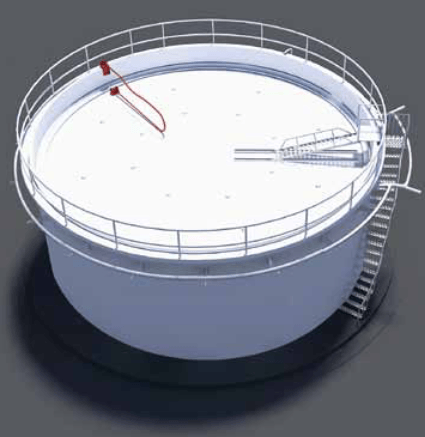 Most tanks are equipped with flexible stainless steel grounding shunts around the perimeter of the floating roof. These shunts are attached to the roof, and bent upward and outward to press against the tank shell wall. They ride against the tank shell wall, up and down as the roof rises and falls. As you can imagine, the electrical contact to the wall is only good when the tank is new and the wall is clean. After a few trips up and down, the tank wall becomes coated with a variety of substances that compromise the electrical bond. Because of the short length and frequent spacing of these shunts, they are the preferred path of equalization between the floating roof and tank shell for the high-energy short duration component of the lightning strike. API 545 recommends employing these shunts for this purpose. However, because of the imperfect electrical connection to the tank wall, these shunts tend to emit a shower of sparks when they perform their intended function. One solution suggested by 545 is to relocate these shunts so they are submerged under the stored product and there is no oxygen available at the source of the sparks to support ignition. This may create other problems when the roof is landed, thus will be the subject of another article.
To address the lower energy, long duration component of the lightning strike, API 545 recommends the installation of by-pass conductors between the floating roof and tank shell at intervals not to exceed 100’ around the roof perimeter. These conductors provide a low-resistance bonding path between the roof and tank shell, and are intended to prevent ignition-causing arcs generated by this current flow.
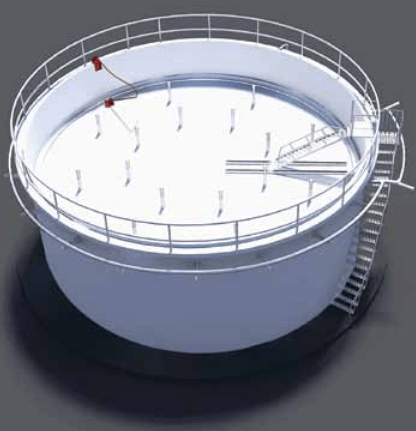 Several iterations for this bonding by-pass conductor have been offered in recent years. In the late 1990’s, we designed a grounding reel in response to a request by Engineering for the Petroleum and Process Industries (ENPPI) in Cairo, Egypt. This reel system was similar to that used to bond a fuel truck to an airplane, with several important differences. This system employed a flat, braided, tinned copper strap. The strap offered lower surge impedance than a round conductor, and, as the strap retracted into the reel, it was pressed against the inner windings of strap, effectively shortening the overall length of the conductor. Because of the high cost and questionable durability, we elected not to produce this system.
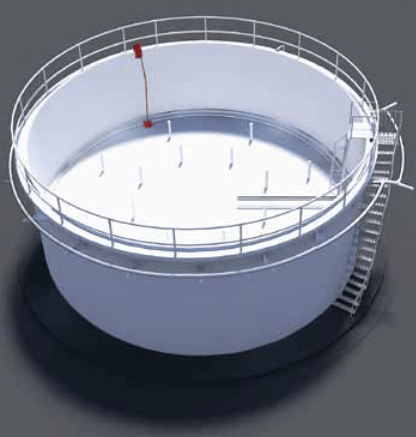 Indeed, as the by-pass conductor is intended to address the lower-energy longer duration component of the lightning discharge, it turns out that almost any conductor of sufficient size is adequate for this propose. Simply attaching a length of conductor from the edge of the floating roof to the top of the tank shell is adequate. However, the problem is keeping this conductor out of trouble. In response to this need, we developed a simple, reliable, low-cost by-pass conductor solution (patent pending). It consists of an adjustable mechanism that attaches mechanically and electrically to the perimeter of almost any type of floating roof. It may be “aimed” to miss tank appurtenances that may foul the conductor. The conductor runs through a tube from this anchoring mechanism to the top of the tank shell. The tube encloses and supports the conductor for slightly under half its length. An appliance is attached to the end of the tube to govern the bending radius of the conductor as it exits the tube. The conductor is then run back to the top of the tank shell. There it attaches with another appliance designed to govern its bending radius, assure that it is electrically bonded to the tank shell wall, and prevent it from fouling on tank appurtenances.
Is there a difference in performance between a retractable reel system and a simple conductor? Theoretically, yes, practically, no. The electrical performance of a simple conductor is adequate to the required task. Additionally, the simplicity of the simple conductor system, enhanced by a mechanism to reduce stresses and keep it out of trouble, indicates a system that will provide years of reliable and trouble-free service, at a greatly reduced cost.
The lightning protection bonding on a tank is a cost item. It does not make the tank better, last longer, or store more product. It simply provides lightning bonding. Therefore, employ the least complex, lowest cost system that performs as required.